Small Things, Big China · Culture
A Tapestry of a Legendary Land: How a 900-Year-Old Painting Became a Dance Drama只此青绿——舞绘《千里江山图》
A quiet handscroll, a now-iconic shade of blue-green and a contemporary stage production that asks what it means to inherit a work of art.
Quick answer: A Tapestry of a Legendary Land (只此青绿) is a contemporary Chinese dance-poem drama inspired by Wang Ximeng’s Northern Song handscroll A Thousand Li of Rivers and Mountains. It does not simply reenact a painting. It turns landscape, pigments and the labor behind the scroll into movement.
You may first encounter A Tapestry of a Legendary Land as a single image: dancers leaning backwards in long blue-green costumes, their bodies forming the rise and fall of a mountain range.
That image is striking, but it is only the doorway.
The full stage work begins with a painting made more than nine centuries ago. It moves through the imagined world of a young painter, the craftspeople who prepared his materials and a present-day museum researcher trying to understand how such an object reaches us at all. For a traveler, it offers something more interesting than a conventional “traditional culture” show: it is a contemporary interpretation of how China looks at its own past.
First, why does the English title seem to change?
If you search for the production in English, you may find more than one name. Shanghai’s official tourism listing and the 2024 film use A Tapestry of a Legendary Land. The National Centre for the Performing Arts has listed the stage production as The Journey of a Legendary Landscape Painting. Some venues use closely related versions.
They refer to the same core stage work. The variation is translation, not a second production.
- Chinese title
- 舞蹈诗剧《只此青绿》——舞绘《千里江山图》
- Main English title
- A Tapestry of a Legendary Land
- Also listed as
- The Journey of a Legendary Landscape Painting
- What to search
- 只此青绿 + city name, or either English title + “dance drama”
The painting behind the performance
The production takes its inspiration from A Thousand Li of Rivers and Mountains (《千里江山图》), a handscroll attributed to Wang Ximeng and held by the Palace Museum in Beijing.
Created during the Northern Song dynasty, the scroll is almost 12 metres long. It unfolds through layered peaks, waterways, paths, bridges, boats and small signs of human life. The landscape is built in the blue-green tradition of Chinese painting, using mineral pigments that give the mountains their distinctive turquoise, malachite and azurite tones.
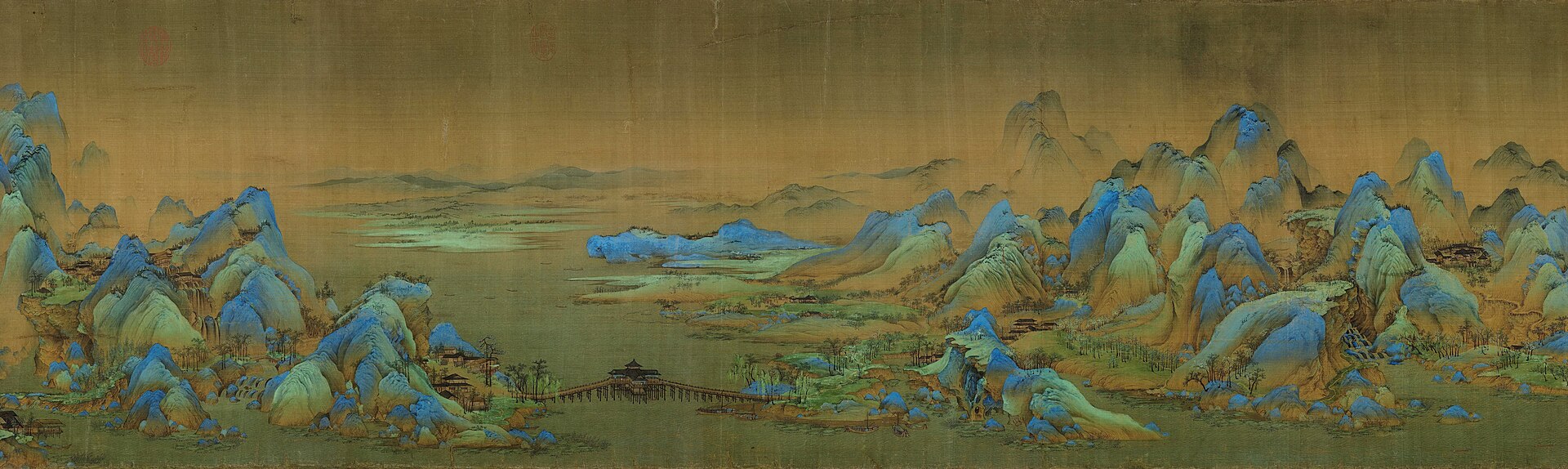

Wang Ximeng has become part of the work’s fascination, but reliable historical information about him is limited. The stage production imagines his creative world; it should not be treated as a literal biography. That distinction makes the work more—not less—interesting. It shows how contemporary artists can build an emotional bridge across gaps in the archive without pretending those gaps do not exist.
How do you turn a scroll into choreography?
The production uses a present-day “scroll keeper,” often described as a Palace Museum researcher, as its guide. As the painting approaches display, he imaginatively enters the process of its creation and encounters the young painter Ximeng.
The work then moves through chapters associated with opening the scroll, seal script, silk, stone, brushwork, ink and painting. This structure expands the story beyond a single inspired genius. The scroll could not exist without people preparing silk, grinding mineral pigments, making brushes and preserving the finished object.
Group formations rise, pause and descend like peaks seen across a handscroll.
The palette is not decorative shorthand for “ancient China”; it grows directly from the painting’s mineral pigments.
Some of the most powerful moments come from bodies held almost motionless, as if a painted landscape has briefly learned to breathe.
The famous backward-leaning pose is therefore not a party trick isolated from the rest of the work. It is part of a larger visual grammar. Dancers become ridgelines; sleeves and skirts extend the movement of water and mist; stillness gives the eye time to “travel” across the stage as it might travel across an unfurled scroll.
This is also why calling the production an ancient dance would be misleading. It premiered in the twenty-first century. Its power comes from the conversation between historical material and contemporary choreography, lighting, composition and stage design.
Can you enjoy it without speaking Chinese?
Yes—but it helps to arrive with a little context.
The storytelling is led by movement and visual composition, so Chinese fluency is not essential for appreciating the performance. At the same time, the live stage production should not be advertised as completely language-free. Venue listings, projected text, surtitles and programme notes vary.
Before you go, remember just four things:
- The painting is A Thousand Li of Rivers and Mountains.
- Its attributed painter is Wang Ximeng.
- The “scroll keeper” belongs to the modern framing story.
- The craft chapters explain that a masterpiece is also the result of materials, knowledge and many hands.
That is enough to follow the emotional arc without turning the evening into an art-history exam.
Stage production or film?
A film adaptation was released in 2024 under the same English title, A Tapestry of a Legendary Land. It is based on the dance-poem drama but uses cinematic framing, editing and viewpoint. It is not simply a fixed camera recording of a theatre performance.
| Live stage production | 2024 dance film | |
|---|---|---|
| Experience | Shared, full-stage composition; your eye chooses where to look. | Camera and editing direct your attention and bring you closer to detail. |
| Language | Check the specific venue for programme notes and surtitles. | Official descriptions present the film as a dance-led, dialogue-free work. |
| Search term | Add “dance drama,” a city or a theatre name. | Add “2024 film” or “dance film.” |
If you can choose only one, the stage production makes the group formations and scale especially vivid. The film is a useful alternative when the tour does not meet your route—and it offers a different way to see details that may disappear inside a large theatre.
What this says about culture in China now
It is tempting to describe A Tapestry of a Legendary Land as “traditional culture becoming popular again.” That is too simple.
The more revealing point is that preservation and reinvention increasingly appear side by side. A museum conserves an original object. Choreographers, composers, designers, performers, cultural institutions and touring theatres then create a new work around it. The stage production later moves into cinema, reaching another audience through another medium.
One does not replace the other. You do not need to believe that watching the dance is equivalent to seeing the scroll, or that the scroll needs a stage spectacle to remain important.
These productions illustrate one strand of contemporary Chinese stage-making: heritage is not simply reproduced, but re-authored through choreography, design, institutional collaboration and touring.
This is a useful way to understand cultural development in China today. Tradition is treated not only as a finished chapter to be protected, but also as material that artists can continue to think with.
Another production to know
Tiangong Kaiwu: when knowledge and labor take the stage
If A Tapestry of a Legendary Land asks how a landscape can acquire a body, Tiangong Kaiwu (舞剧《天工开物》) asks how technical knowledge can become physical again.
This is Lu Chuan’s 2024 dance drama, inspired by the Ming-dynasty scholar Song Yingxing and his 1637 book Tiangong Kaiwu, commonly translated as The Exploitation of the Works of Nature. The book records knowledge of agriculture, textiles, ceramics, metallurgy and other forms of production. The stage work is not a chapter-by-chapter reconstruction and not simply a biography of Song Yingxing. It connects his search for knowledge with collective scenes of making and labor.
Its creative language is correspondingly different: large stage objects, visual motifs drawn from the book’s line illustrations, multimedia imagery and sounds associated with forging, bellows, fields and weaving. Where A Tapestry of a Legendary Land often feels suspended and contemplative, Tiangong Kaiwu is grounded in process—the physical intelligence of people transforming materials.
Together, the two works make a compelling pair. One begins with a celebrated painting; the other with a technical text. Both reject the idea that cultural heritage must remain still in order to be respected.
How to plan a performance during your China trip
Performance information last reviewed: 17 August 2026. Touring dates, ticket status, casts, runtimes and language support vary by city and venue.
Neither production belongs to one permanent theatre. They tour, and the practical details can change by city and date. A runtime of around two hours, for example, appears in official listings for particular performances, but should not be treated as a universal promise.
- Search the Chinese title as well as the English one.
- Confirm the exact city, theatre and performance date.
- Use the theatre, producer or authorised ticketing channel.
- Check whether ticket sales are open—not only whether a performance has been announced or licensed.
- Review ID or passport requirements for ticket collection and entry.
- Confirm the start time, runtime, intermission and late-arrival policy.
- Ask whether English programme notes or surtitles are available.
- Do not assume an old poster or social post reflects the current cast, city or ticket status.
Want to see one during your trip?
Chinese dance productions tour from city to city, and performance dates, casts and authorised ticketing channels can change. Tell trisAino Concierge where and when you are travelling. We can check the latest official schedules, identify the authorised seller and help with booking where tickets are available.
Check performances with ConciergeSchedules, seat availability and successful ticket purchase cannot be guaranteed.
Frequently asked questions
What is the English title of 只此青绿?
A Tapestry of a Legendary Land is widely used. The National Centre for the Performing Arts has also used The Journey of a Legendary Landscape Painting. Both can refer to the same dance-poem drama.
What painting inspired the production?
It is inspired by Wang Ximeng’s Northern Song handscroll A Thousand Li of Rivers and Mountains (《千里江山图》), in the collection of the Palace Museum in Beijing.
Is it an ancient Chinese dance?
No. It is a contemporary stage work first presented in 2021, using modern choreography and design to interpret a historical painting and the crafts behind it.
Is A Tapestry of a Legendary Land a stage show or a film?
Both exist. The live dance-poem drama came first; a film adaptation was released in 2024. Add “dance drama” or “2024 film” when searching.
How long is the live performance?
An NCPA listing gave an approximate runtime of 120 minutes including an intermission, but runtime is venue-specific. Check the ticket page for your exact performance.
Can I follow it without Chinese?
The movement and visual storytelling are accessible without fluent Chinese, especially if you read a short synopsis first. Language support and surtitles vary by venue.
How do I find official dates and tickets?
Search both Chinese and English titles, then verify the result through the producer, theatre or authorised ticketing channel. trisAino Concierge can help check the current schedule and booking route for your travel dates.
Sources and verification notes
Performance dates, casts, ticket status, runtime and language support are time-sensitive and should be verified for the specific venue.
- China Oriental Performing Arts Group / Ministry of Culture and Tourism: production background and story
- National Centre for the Performing Arts: alternate English title, structure and venue-specific runtime
- Shanghai official tourism listing: A Tapestry of a Legendary Land
- Palace Museum: A Thousand Li of Rivers and Mountains
- Wikimedia Commons: CC0 image used in this article
- Ministry of Culture and Tourism: 2024 film adaptation
- CCTV Spring Festival Gala on YouTube: 2022 performance excerpt
- Jiangxi Performing Arts Group: Tiangong Kaiwu production and creative team
- National Copyright Administration: Tiangong Kaiwu story and stage approach