AI Planning and Practical Travel Guidance: The Combination a China Trip Needs

The answer is two layers, and they're built in a specific order
The best combination isn't two tools that do similar things. It's one that decides what happens on each day, and another that makes each day executable, used in that order. AI planning is strong at the first job. Give it dates and interests and it will produce a reasonable structure faster than you could build one by hand. What it can't tell you is whether you'll be able to pay at the restaurant on day three, board the train on day five, or check into the hotel on the night you land. Those are separate questions, they have their own lead times, and they're where China trips usually come apart.
What AI planning is genuinely good at
It's worth being specific about this, because the strengths are real and they're the reason people start there.
A generated itinerary turns a vague idea into a structure in a few minutes. It groups sights by geography so you're not crossing a city twice. It reshapes quickly when you add a constraint, so "eight days, no early mornings, one day outside the city" produces a different plan rather than a rewritten paragraph. Most usefully, it lets you compare two or three versions of a trip before committing to one, which is the part that's genuinely tedious by hand.
That's the route layer, and for that layer the tooling has gotten good.
What a generated itinerary quietly assumes
Read a good AI-generated China itinerary closely and you'll notice it takes a number of things for granted.
It assumes you can pay. Mobile payment covers most everyday transactions, and setting it up involves identity checks and card linking that your bank may need to approve, which is much easier to complete at home than from a hotel room.
It assumes you have data on arrival, that your maps work locally, and that translation is available offline when it isn't.
It assumes you can buy the intercity ticket, which involves real-name booking and carrying the passport used to book it. It assumes the museum on day four is open that day and still has capacity. It assumes the hotel can complete your registration.
None of these assumptions are unreasonable. They're just invisible, and each one has a setup step behind it.
The two layers fail differently, which is why the order matters
A route mistake and a preparation mistake feel nothing alike.
| Layer | What it answers | How a mistake shows up | When to build it |
|---|---|---|---|
| Route | Where you go, in what order, for how long | You skip a sight, shorten a day, or move something | First, roughly |
| Preparation | What has to work for that route to run | You're standing at a counter with no way forward | After the rough route, before the detail |
Route mistakes are recoverable in the moment. You drop the second temple and have a longer lunch. Preparation mistakes usually aren't, because the thing you needed had a lead time that has now passed. A wallet that needs bank verification can't be verified at the ticket window. A rail account that needs identity confirmation can't be confirmed on the platform.
That asymmetry is the whole argument for treating preparation as a layer rather than a packing list.
Rough route first, then preparation, then the detail
The sequence people default to is: plan everything, then prepare. A better sequence has three steps.
Build the route roughly. Cities, days, and the intercity legs. You don't need restaurant choices yet.
Work through what that specific route requires. This is why the rough route comes first: a trip with three train legs needs a rail account and a passport-matched booking, and a trip that flies everywhere doesn't. Preparation is route-dependent, so preparing before you know the shape means preparing for a trip you're not taking.
Fill in the daily detail last, once the constraints are known. Reservation windows, opening days and transfer times will change some of your choices, and it's cheaper to learn that before you've built an hour-by-hour plan around them.
Most of the wasted effort in trip planning comes from doing step three before step two.
What to verify no matter which tool produced the plan
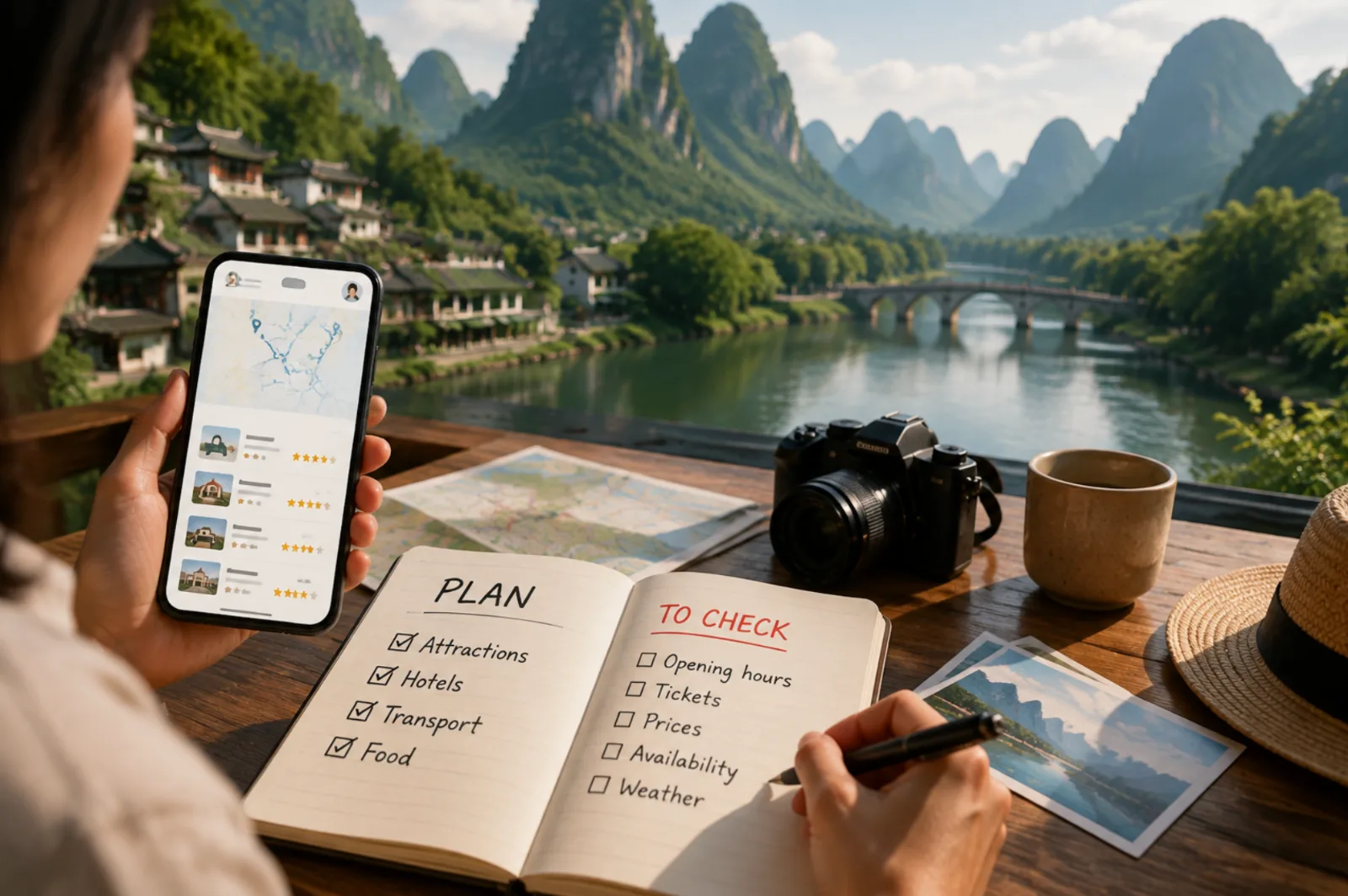
Any planning tool, AI or otherwise, is working from information that was true at some point. A few categories change often enough that they should be confirmed against the source rather than trusted from a plan:
-
Opening hours, closure days and whether a venue requires timed-entry reservation. Check the venue's own channel.
-
Ticket prices and whether every traveler needs an individual booking.
-
Rail schedules, station assignments and the booking window, which you can confirm through the official 12306 channels.
-
Entry requirements and the arrival card process, which are published by the National Immigration Administration.
A plan that looks precise isn't the same as a plan that's current. Treat generated specifics as a starting point to check, not a result to act on.
How the two layers fit together in practice
trisAino is built around this split rather than trying to collapse it into one product.
Planner handles the route layer. You give it your dates, arrival city and pace, and it produces a city and day framework you can reshape and compare. It's a starting point for the structure, not a booking engine, so hotels, transport and tickets still go through the operators that issue them.
Guide handles the preparation layer. It organizes the setup steps by the situations you'll actually run into rather than by category, which matters because the useful question isn't "what apps exist" but "what has to be working before I get in a taxi at 11 p.m." Each item opens into a step-by-step tutorial, and part of it is available as a free preview.
trisAino combines Planner for shaping an itinerary, Guide for practical China travel information, and Concierge for bilingual human support when something needs a person rather than a page.
BUILD BOTH LAYERS Open the trisAino Planner to shape the route around your real dates, then work through the Guide for the payments, connectivity, booking and arrival steps that route depends on. Part of the Guide is available as a free preview, so you can see the structure before unlocking the full checklist.
A test for whether your plan is actually finished
Go through the itinerary one day at a time and ask a single question: what would stop this day from happening?
For most days the answer is something concrete. Day one stops if the hotel can't process your passport. Day four stops if the museum needed a reservation you didn't make. Day six stops if the train was booked under a name that doesn't match your document.
If the answer for a given day is "nothing, I just go there," you've probably found a day you haven't checked rather than a day with no dependencies.
That question is the join between the two layers, and it takes about ten minutes to run across a ten-day trip.
Plan the trip, then plan for the trip
The reason this combination comes up as a question is that AI made the first layer feel like the whole job. A generated itinerary looks finished. It reads like a plan, it's specific, and nothing in it announces what it's assuming. The gap only becomes visible on the ground, which is the worst place and time to discover it.
So build the route where it's fast to iterate, then work the preparation layer against that specific route, and verify the few categories that go stale. If you want both layers in one place, the trisAino Planner covers the route and the Guide covers what the route assumes. If you'd rather assemble it yourself, the sequence still holds, and it's the sequence that does most of the work.
Frequently asked questions
Can AI plan a China trip on its own?
It can produce the route reliably: cities, days, sequence and a sensible geographic grouping. What it doesn't cover is the setup behind that route, including payment verification, connectivity, real-name rail booking and accommodation registration. Treat a generated itinerary as a strong first draft of one layer rather than a complete plan.
What does an AI itinerary usually leave out for a China trip?
Most often the preconditions and the lead times attached to them. Payment app verification, mobile data arranged before departure, a rail account matching your passport, timed-entry reservations, and hotel registration all sit behind an itinerary without appearing in it. Specifics such as opening hours and booking rules can also be out of date.
Is the trisAino Guide an official source?
No. It's a practical planning resource that organizes common travel tasks in the order you'll meet them. For anything affecting entry, safety, money or reservations, use the official immigration, transport, payment, aviation and venue channels, which the Guide points toward rather than replaces.
Should I prepare the practical setup before or after planning the route?
Build the route roughly first, then prepare against it. Preparation is route-dependent, so knowing whether you're taking trains, flying, or staying in non-hotel accommodation changes what you actually need to set up. Save the daily detail for last, once reservation windows and transfer times are known.
Entry and rail references point to official channels, which are the sources to check for current rules. Product details were checked against the current product pages before publication and can change.