China Travel Checklist 2026: What to Prepare Before You Go
A practical pre-trip checklist for China covering entry rules, documents, payments, internet, maps, hotels, bookings, and backup plans.
Planning
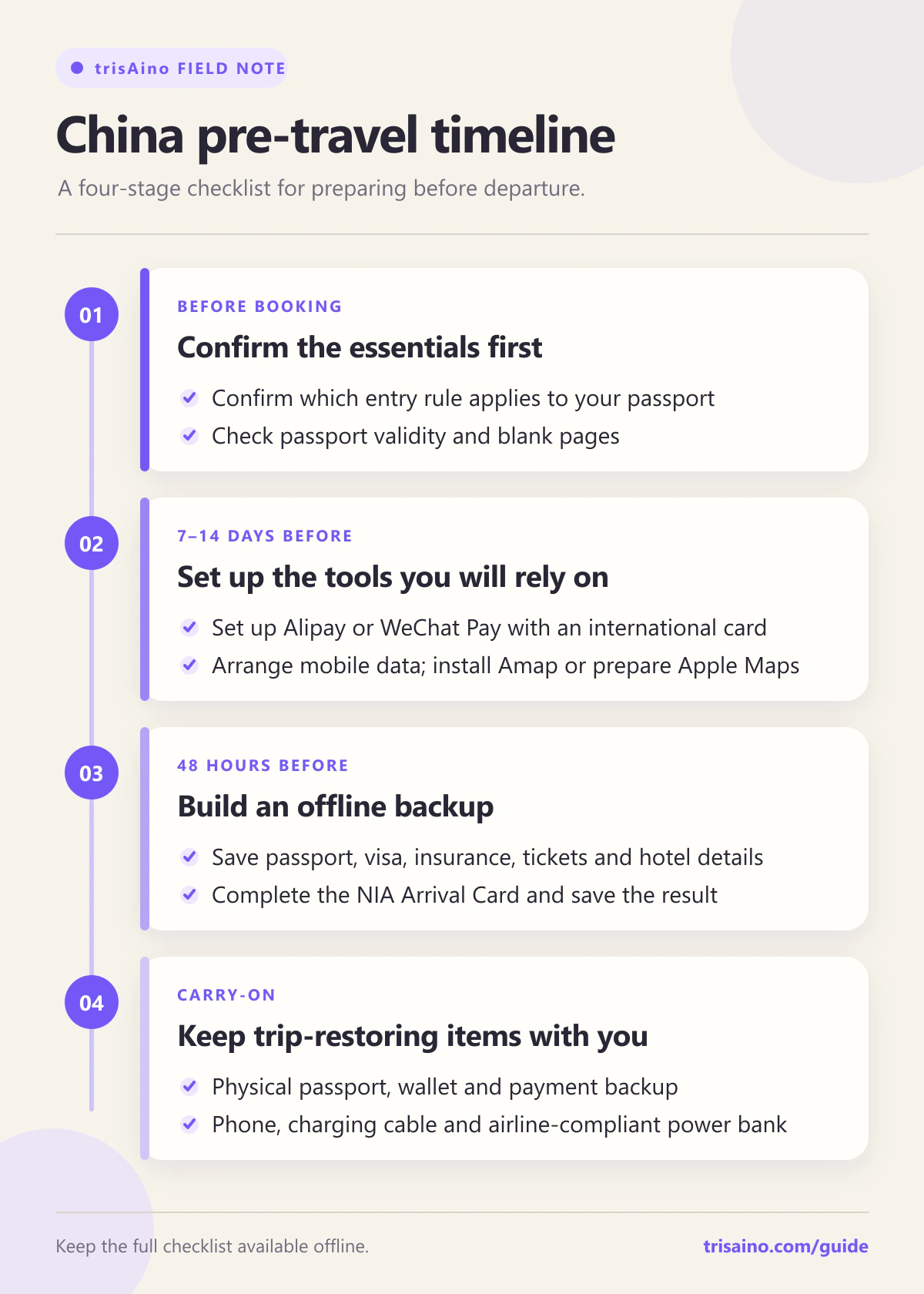
Short answer: Before traveling to China, confirm which entry rule applies to your passport, prepare your physical passport and backups, set up at least one mobile-payment method, arrange mobile data, install a map that works locally, save your hotel address in Chinese, and reserve any time-sensitive transport or attractions. Do the account setup before you fly. The most common problems are not complicated; they are small tasks that become hard when you are tired, offline, or standing at a counter.
Use the official links before departure. Entry and app rules can change.
China pre-travel checklist at a glance
| Task | What to do | When |
|---|---|---|
| Entry eligibility | Check visa, unilateral visa-free entry, mutual exemption, or 240-hour transit eligibility | Before booking a non-refundable flight |
| Passport | Check validity and blank pages; keep the original with you | Before booking |
| Document backups | Save passport, visa, insurance, tickets, and hotel details offline | At least 48 hours before departure |
| Arrival Card | Use the official NIA online channel and save the result | Before arrival |
| Payments | Set up Alipay or WeChat Pay with an international card; carry a backup card and some RMB | Before departure |
| Internet | Arrange a compatible data plan and follow the provider’s installation and activation instructions. | Before departure |
| Maps | Install Amap or prepare Apple Maps; save addresses in Chinese | Before departure |
| Hotel | Confirm the booking name matches the passport and save the Chinese address | Before departure |
| Trains and attractions | Complete passport verification and book high-demand tickets early | As soon as sales open |
| Itinerary | Leave realistic transfer time between airports, stations, cities, and sights | Before locking bookings |
If you prefer to work through these items interactively, open the free China Pre-Arrival Master Checklist. It keeps the preparation steps in one place and lets you mark them off as you go.
Do I need a visa to travel to China in 2026?
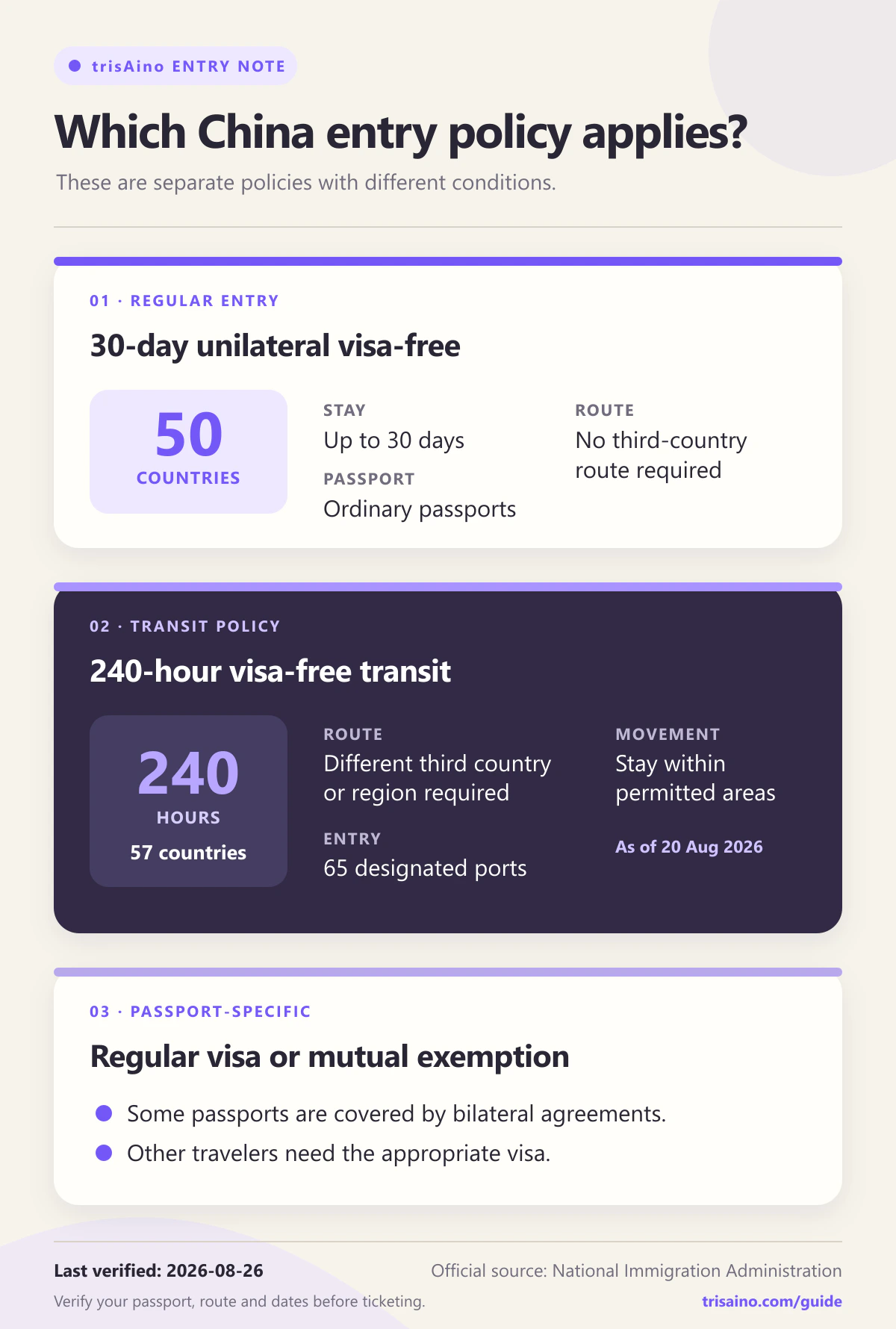
There is no single rule called “China visa-free travel.” Several different policies exist, and confusing them is the fastest way to create a problem at airline check-in.
1. China's 30-day unilateral visa-free policy
As of February 17, 2026, nationals of 50 countries holding ordinary passports may enter China without a visa for up to 30 days for tourism, business, family visits, exchange visits, or transit. This is regular entry. You do not need an onward ticket to a third country solely to qualify for this policy.
The United States is not on this 50-country unilateral list. Canada is on it. Do not infer eligibility from region alone; check the complete National Immigration Administration country list.
2. The 240-hour visa-free transit policy
This is a separate transit policy. Following an update effective August 20, 2026, it covers nationals of 57 countries. Eligible travelers may enter through one of 65 designated ports and remain for up to 240 hours, or 10 days, within the permitted areas.
The key condition is your route: you must be traveling onward to a different third country or region with a confirmed seat and departure date. A route such as London to Shanghai to Tokyo can qualify. London to Shanghai to London does not meet the third-destination requirement.
Travel is limited to the policy’s designated areas. Check the current permitted-area and eligible-port lists in the official 240-hour policy conditions and the August 20, 2026 expansion announcement before ticketing.
3. Mutual visa exemptions and regular visas
Some passports are covered by bilateral or mutual visa-exemption agreements with different stay limits. Other travelers still need a visa. The visa printed in your passport may also have conditions that differ from the general policies above.
Avoid this mistake: Do not rely on a social post, an old screenshot, or a generic “visa checker” as your final authority. Verify your passport, purpose of travel, route, port, and dates with the NIA, the Chinese embassy or consulate responsible for your location, and your airline before departure.
Which documents should I prepare for China?
Carry the physical passport
Your passport is not only for immigration. You may need the original document for hotel registration, railway travel, domestic flights, and some ticketed attractions. Keep it secure, but do not leave it behind on a day when a booking is tied to your passport number.
A six-month validity buffer is a sensible planning rule because many Chinese visa application processes and airline checks use it. It is not a substitute for checking the exact rule for your passport and entry method.
Create an offline document pack
Save these to your phone and to a second location you can reach without your main device:
- Passport information page
- Chinese visa or residence document, if applicable
- Return or onward ticket
- Travel-insurance certificate and assistance number
- Hotel confirmation and full address in both English and Chinese
- Emergency contact at home
- Prescription or doctor's letter for important medication
Emailing the pack to yourself is useful, but also save an offline copy. Airport Wi-Fi and account logins are poor things to depend on when your phone number or password is not working.
Complete the official China Arrival Card
The NIA provides an official online Arrival Card channel. Complete it before travel when possible and save the result to your phone. Use the official NIA Arrival Card guidance, not a paid lookalike website.
Know the accommodation-registration rule
Hotels register foreign guests when they check in. If you stay in a private home or another non-hotel residence, you or your host generally need to complete accommodation registration within 24 hours of arrival. Since March 2026, online registration has been piloted in several provincial-level regions through the NIA website, NIA 12367 app, and its WeChat and Alipay mini-programs. Where the online service is not available, use the local public-security channel. See the official accommodation-registration explanation.
Which payment apps should I set up before China?
Set up Alipay or WeChat Pay before departure and link an international bank card. China's official guide for foreign visitors says the platforms can accept major international card networks, but your card issuer still has to approve verification and transactions.
Use this backup structure:
- One mobile-payment app that you have opened and identity-verified
- A second international card from a different account or issuer
- A modest amount of RMB cash for situations where your phone, data, or card does not cooperate
If you plan to use high-speed rail, create your 12306 account early. Foreign travelers can use a passport on the English website or app, but identity verification may require a passport-image review. The official guide for foreigners in China explains current payment, train, transport, and accommodation options.
Avoid this mistake: Installing an app is not the same as being ready. Open it, complete identity verification, link the card, and confirm that you can reach the payment screen before flying. Do not send a test payment to an unknown merchant just to see whether it works.
How should I arrange internet access in China?
For a short trip, a travel eSIM is usually the fastest option if your phone supports it. Confirm three things before buying:
- The plan explicitly covers mainland China
- Your phone is unlocked and supports the required eSIM bands
- The provider explains how its data is routed and which international services it expects to support
International-app access varies by provider and plan, so do not treat any eSIM promise as permanent. Keep offline copies of your hotel address, tickets, insurance details, and first-day route.
A local SIM is another option. Foreign visitors can apply in person at an official China Mobile, China Unicom, or China Telecom service hall with a passport. The current SIM-card guide for foreign nationals says the applicant must appear in person.
Which map should I use in China?
Do not make one international map service your only navigation plan. Install a locally supported option before departure:
- Apple Maps is a practical English-language option for many iPhone users in mainland China.
- Amap, also called Gaode Maps, is our preferred local option and offers an English interface on supported versions.
- Save the Chinese name and address of each hotel, airport terminal, railway station, and major attraction as text and as a screenshot.
The Chinese address matters because a taxi driver, hotel desk, or station employee can act on it immediately. A translated hotel brand without the street address may not be enough in a city with multiple branches.
What should I book before flying to China?
Prioritize bookings that can break the rest of the itinerary:
- The first hotel, under the same name shown in your passport
- Intercity trains or domestic flights that connect fixed hotel dates
- High-demand attractions with passport-based reservations
- Airport transfer plans, especially after the last metro or express train
Also check Chinese public holidays and attraction closure days before finalizing the route. The practical question is not only “Can I get a ticket?” It is whether one missed reservation forces you to rebuild two or three days around it.
What should I keep in my carry-on?
Keep the things that restore your trip if checked luggage is delayed:
- Physical passport and wallet
- Phone, charging cable, and a clearly labeled airline-compliant power bank
- Essential medication in original packaging
- One change of clothes
- Printed or offline hotel details
- Insurance contact and document copies
- A pen for forms
Check your airline's current battery and medication rules. Do not move an unlabelled or oversized power bank into checked luggage as a workaround.
Also save the China emergency numbers every traveler should know with your offline documents, including 110 for police, 119 for fire, and 120 for an ambulance.
The five preparation mistakes that cause the most friction
- Treating all visa-free policies as interchangeable. Regular 30-day entry and 240-hour transit have different conditions.
- Depending on one card, one app, or one phone. Build a second payment and document path.
- Saving only English place names. Keep the full Chinese address for every critical location.
- Leaving account verification until arrival. Airport time is for following signs, not debugging bank-card authentication.
- Planning by map distance alone. Security checks, passport verification, station size, and attraction entry windows all consume time.
Turn the checklist into a workable itinerary
Preparation removes friction, but it does not decide how many days Beijing needs, whether Xi'an fits between Shanghai and Chengdu, or which attraction should go on which day.
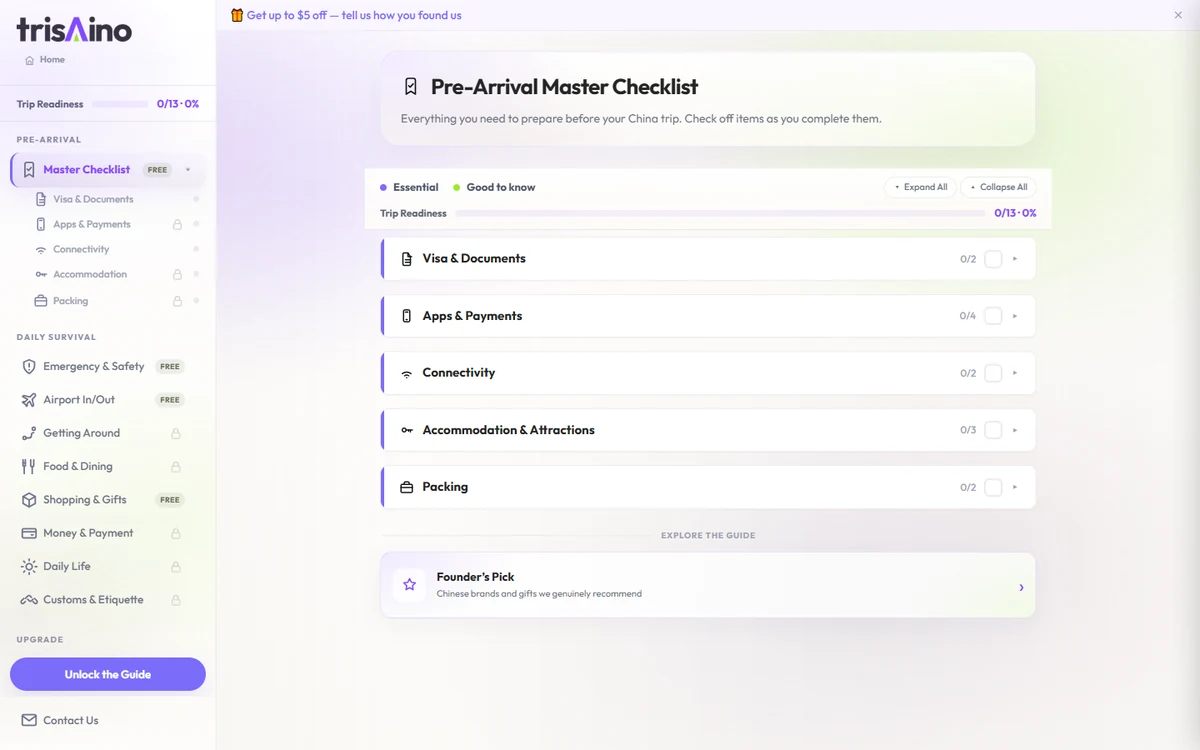
Use the free trisAino Pre-Arrival Master Checklist to work through the setup. When the practical layer is under control, build a realistic day-by-day route with the free trisAino Planner.
How this checklist is verified
The trisAino editorial team checks entry and transit rules against the National Immigration Administration, and checks arrival, accommodation, payment, rail, and SIM procedures against Chinese government and ministry sources. When a policy count, eligibility rule, or required procedure changes, we update the affected passage and the visible verification date. App and map recommendations are editorial guidance, not government requirements.
FAQ
What do I need before traveling to China for the first time?
At minimum, confirm entry eligibility, carry a valid passport, save document backups, arrange mobile data, set up a mobile-payment method, install a locally supported map, save your hotel's Chinese address, and reserve time-sensitive transport and attractions.
Do US citizens get 30 days visa-free in China?
Not under the 50-country unilateral 30-day policy current on August 26, 2026. US citizens are included in the 240-hour visa-free transit policy if their route, port, onward ticket, and permitted stay area meet all conditions. Otherwise, they need the appropriate visa or another applicable entry policy.
Is 240-hour visa-free transit the same as ordinary visa-free entry?
No. It requires transit to a different third country or region, entry through an eligible port, and travel within the permitted area. Ordinary unilateral visa-free entry does not require a third-country itinerary solely for eligibility.
Can foreign cards be used in Alipay and WeChat Pay?
Major international card networks are supported, but identity verification, issuer approval, limits, and fees can vary. Set up the account before departure and keep another card plus some RMB as backup.
Can I use Google Maps as my only map in China?
It is not a reliable single plan for mainland China. Prepare Apple Maps or Amap and save the Chinese addresses of hotels, stations, airports, and attractions offline.
Sources
- National Immigration Administration: 2026 unilateral visa-exemption country list
- National Immigration Administration: Visa-Free Transit Policies
- National Immigration Administration: August 20, 2026 transit-policy expansion
- National Immigration Administration: Online Arrival Card guidance
- State Council: Accommodation registration for foreigners
- State Council and Ministry of Commerce: Guide to Working and Living in China
- Ministry of Industry and Information Technology: SIM-card guide for foreign nationals
This article is practical travel guidance, not immigration or legal advice. Entry decisions are made by the relevant authorities and carriers.