Visiting China vs Other Asian Countries: The Practical Differences
The difference is defaults, not difficulty
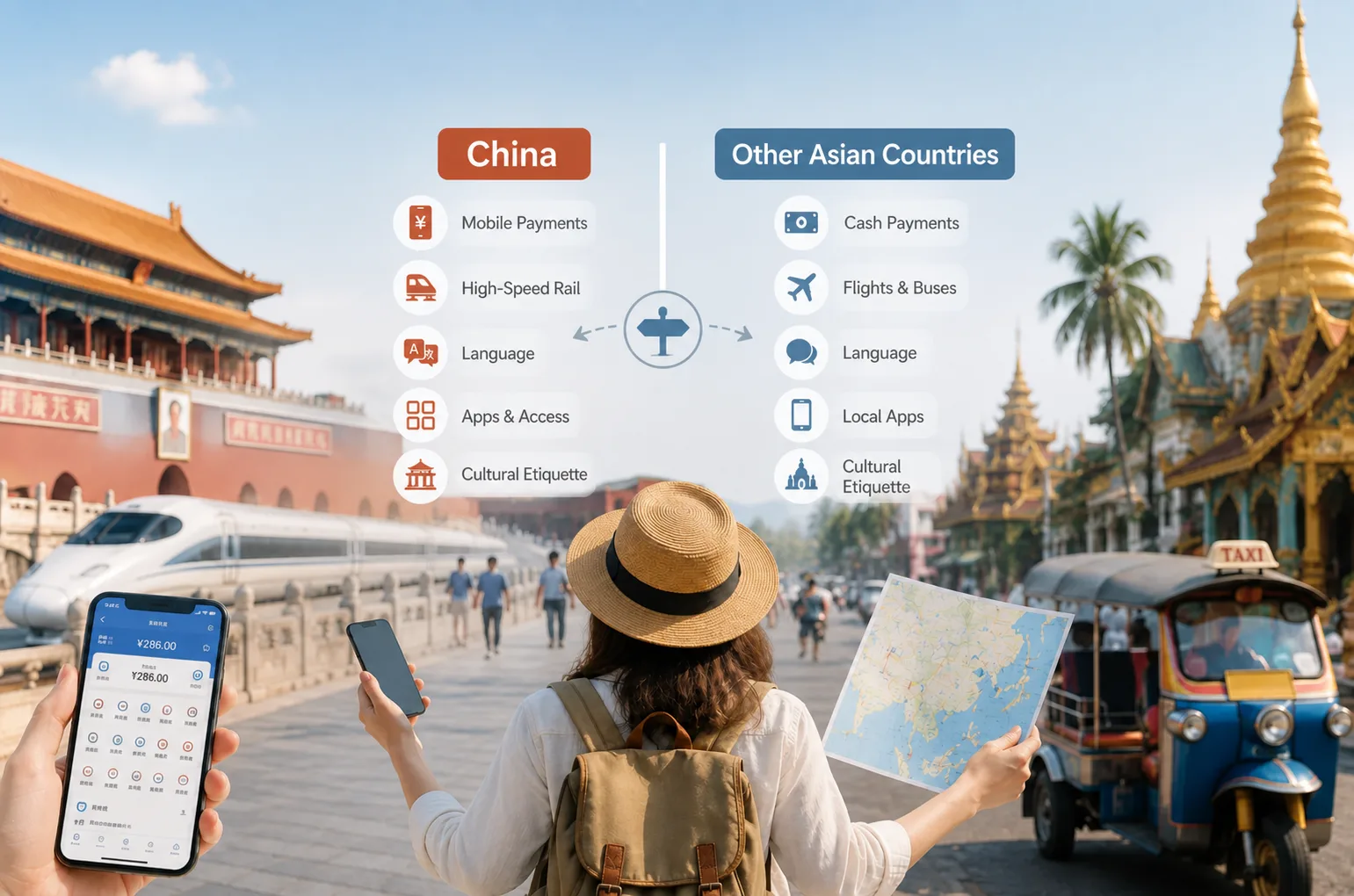
If you have travelled in Japan, Thailand, Vietnam or Singapore, you already have most of the skills a China trip needs. What differs is not how hard things are but which system is the default. Payment, transport booking and everyday apps all work well in China, and they work through a different set of defaults than the ones you may have got used to elsewhere in the region. That gap is worth mapping in advance, because prior experience in Asia tends to produce confidence in habits that do not transfer, which is a different problem from arriving with no experience at all.
Why experience elsewhere in Asia can work against you
A first-time traveller with no regional experience looks everything up. Someone arriving from three previous Asia trips does not, because most of it worked last time.
That is the actual risk. You do not check whether your card will be accepted, because it was in Bangkok. You do not arrange connectivity in advance, because you bought a SIM at the airport in Hanoi. You assume a rail ticket is a rail ticket, because it was in Japan.
None of those assumptions is unreasonable. They are just tied to a specific country rather than to a region, and Asia is not one system. The countries you have visited differ from each other as much as any of them differs from China.
So the useful preparation is narrow: identify the handful of defaults that are genuinely different, and leave the rest of your instincts alone.
Payments: mobile-first rather than cash-first or card-first
In much of the region you can arrive with a card, a little cash, and no plan. Japan still runs substantially on cash in smaller establishments. Thailand and Vietnam mix cash with card acceptance that varies by venue.
China's everyday default is mobile payment. Alipay and WeChat Pay now accept many international cards, and cash remains legal tender, but a growing number of small vendors, ticket machines and transport interfaces expect a scan rather than a note or a chip.
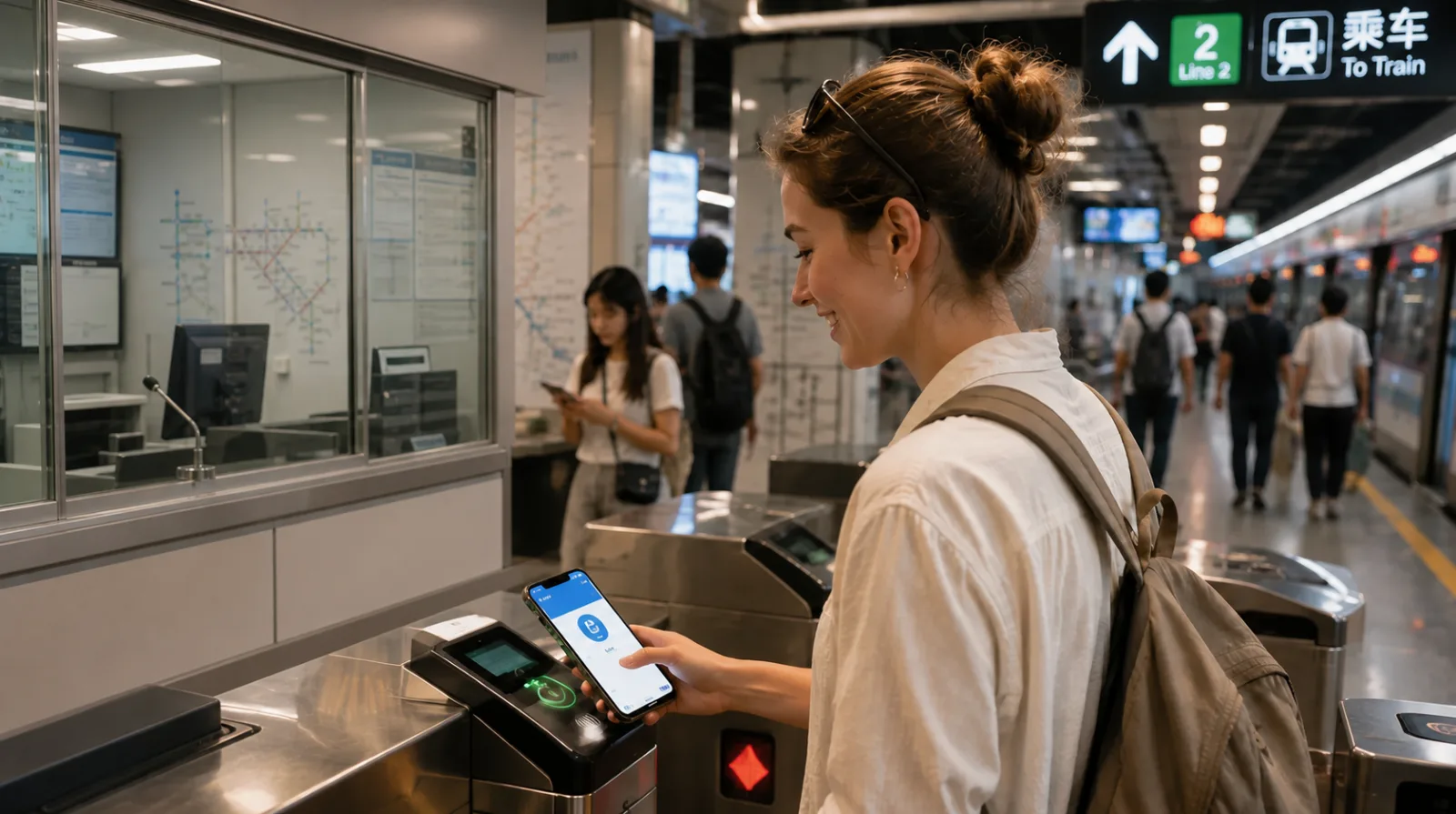
The practical consequence is timing. Linking an international card involves identity checks and sometimes an approval from your own bank, which is straightforward at home over a few days and considerably less so from a hotel room on your first night. Set this up before you fly, and keep some cash as a backup rather than as the primary plan.
Apps: separate tools rather than one super-app habit
Travellers arriving from Southeast Asia often expect a single application to handle rides, food delivery and payment, because that is how the regional platforms are structured there.
China's equivalents are capable but the mapping is different, and the tool you use for rides is not necessarily the one you use for maps or for a venue's booking mini-programme. Expect to install two or three things rather than one, and expect a short adjustment period rather than a difficult one.
Access to international applications can vary by provider, plan and routing, so arrange your connectivity before arrival and test what you plan to rely on once you land and have data.
Trains: real-name booking tied to your passport
This is the difference that most often surprises travellers with strong regional experience, because rail is where their instincts are most developed.
A Japan Rail Pass is a pass. A bus ticket in Vietnam is a ticket. Chinese rail booking is tied to the identity document used to book, which means the passport you booked with is the passport you need to carry, and the name must match. It also means tickets cannot be casually transferred between travellers.
Booking windows and station assignments matter more than in a walk-up system. A large city may have several stations that are not close to each other, and the one printed on your ticket is the one you need. Confirm the actual service through the official 12306 channels rather than planning against a general figure.
Accommodation: not every property registers international guests
Hotels handle guest registration as a matter of routine, and for most travellers this is invisible.
The difference from some neighbouring countries is that not every property is set up to accept international guests, particularly at the smaller and more informal end where a regional traveller might otherwise book without thinking. This is worth confirming at the point of booking rather than at check-in, and it is a reason to be more deliberate about accommodation than you might be in Thailand or Malaysia.
Current entry and registration requirements are published by the National Immigration Administration, which is the source to check rather than a travel article.
Scale: a domestic leg can be longer than an international hop
Southeast Asia rewards a certain kind of improvisation because the distances are short. A flight between capitals can take under two hours, and a spontaneous three-day detour is realistic.
Chinese domestic legs are frequently longer than that. Beijing to Chengdu by rail runs about seven hours or more before local transfers. Two cities that look adjacent on a map can be a full travel day apart.
The consequence is planning rather than difficulty: a route built on the assumption of cheap, short hops will produce an itinerary that spends most of its days in transit. Decide the shape of the trip before you book anything, and treat each intercity leg as a scheduled item rather than something to slot in later.
What transfers over just fine
It is worth being clear about how much of your existing experience still applies, because the list of differences above is short by design.
Airport procedures, hotel standards and the general logic of major-sight ticketing will all feel familiar. Ride-hailing works as a concept. Ordering food by pointing at photographs works as well as it does anywhere in the region. Queue behaviour, luggage storage at stations, and the rhythm of a big-city day are recognisable. English signage is generally good in airports and major transport hubs, and thins out beyond them in much the way it does in most of the region.
Prior Asia travel is an advantage on this trip. It just needs a short list of corrections rather than a blank slate.
Where a structured guide helps
The corrections are known, which means you do not need to discover them one at a time.
trisAino Guide organises these steps by the situations you will actually meet, so payment setup, connectivity, rail booking and arrival details arrive in the order you will need them rather than as a list of topics. Some Guide content is free to preview, and full access is paid. Planner sits alongside it at the free Light level and handles the route, which is what determines which of these differences apply to your particular trip.
MAP THE DIFFERENCES TO YOUR OWN ROUTE Shape the cities and legs in the trisAino Planner first, then work through the Guide. A trip built on three rail legs and a trip built on domestic flights require different preparation, and the guide is more useful once the route is fixed.
Correct a few defaults, keep the rest of your instincts
The most useful thing to take from a comparison like this is not a sense that China requires a different mindset. It requires a different setup, which is a smaller and more solvable thing. Payment configured before departure, connectivity arranged rather than assumed, rail booked under the passport you are carrying, accommodation confirmed as able to register you, and a route built around realistic intercity times.
That is a short list, and everything you learned in Tokyo, Bangkok or Hanoi about how to travel still applies once it is handled. If you want the corrections in the order you will meet them, the trisAino Guide is organised that way.
Frequently asked questions
Is travelling in China harder than in Japan or Thailand?
Not harder, but differently configured. The main systems for payment, transport booking and connectivity have different defaults, and those defaults have setup steps with lead times. Once the setup is done, day-to-day travel feels comparable to other large countries in the region.
Does experience in Southeast Asia prepare me for China?
Partly. Navigation, food ordering, ride-hailing and general travel confidence all transfer. What does not transfer is the specific assumption set around payments, connectivity, real-name rail booking and intercity distances, which is where regional travellers most often get caught by surprise.
What is the single biggest practical difference?
For most travellers it is mobile payment being the everyday default rather than an option, because the setup has to happen before arrival and it affects transactions all day. Real-name rail booking tied to your passport is a close second.
Is the trisAino Guide an official source?
No. It is a practical planning resource that organises common travel tasks in the order you will meet them. For anything affecting entry, safety, money or reservations, use the official immigration, transport, payment and venue channels, which the Guide points toward rather than replaces.
Entry, registration and rail rules are published by official bodies and change periodically. Confirm current requirements through official channels before you travel.