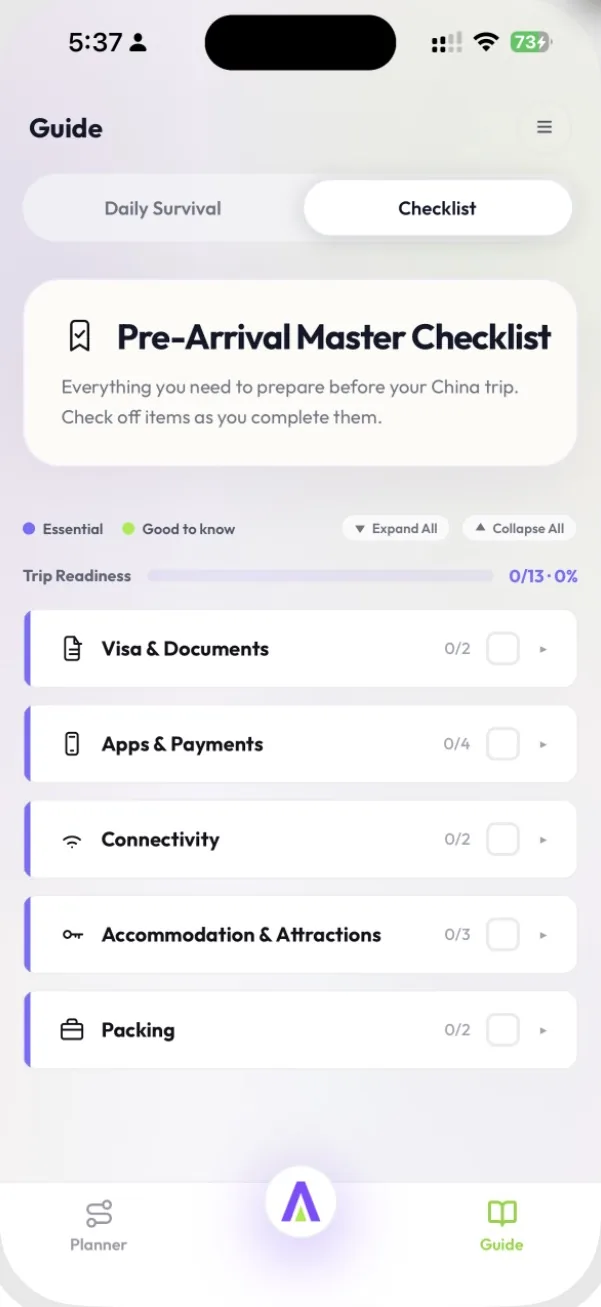
Before your first China trip, confirm how you will enter, pay, get online and reach your accommodation. Then check your key bookings, save arrival details offline and pack around your actual route. Start documents and reservations early; leave the final day for checking that your setup works.
A little preparation makes room for the enjoyable parts: your first bowl of noodles, an evening walk and the cities you have been looking forward to seeing. This checklist helps you turn research into practical decisions before departure.
01 / DOCUMENTS
Confirm your entry arrangements before committing to the trip
Check the rules for your nationality, passport type, travel purpose, dates and complete route. A tourist visa, a visa exemption and a transit arrangement have different conditions. Use the Chinese embassy or consulate responsible for your country and the National Immigration Administration to verify which applies to you.
Read passport-validity requirements for your particular arrangement and any connecting destinations. If you are relying on a transit exemption, check the onward journey, permitted entry points and allowed travel area before booking. A headline about visa-free travel is only the beginning of that check.
Keep your accommodation confirmation, flight details and a simple itinerary available. The embassy’s visa-waiver FAQ recommends carrying supporting documents consistent with your travel purpose; your own entry arrangement determines what you need.
Official reference: Chinese embassy FAQ on visa-free entry. Recheck the guidance for your nationality and travel dates.
02 / PAYMENTS
Set up mobile payments—and carry a second option
Install Alipay and WeChat before departure so you have time to register, complete any checks requested and understand the payment screens. Supported international cards can be linked for eligible payments, although card support and transaction availability vary.
- Link an eligible card and follow the app’s verification prompts.
- Check that your bank and account-verification messages will remain accessible abroad.
- Locate the scan-to-pay and payment-code screens.
- Review fees, limits and your card issuer’s overseas charges.
- Carry a physical card and some RMB cash as backup.
Completing setup at home gives you time to resolve account issues. Make your first small merchant payment after arrival to confirm that the full process works.
The trisAino checklist groups Alipay, WeChat, travel-booking apps and translation tools in one place, making it easier to work through the phone setup in a sensible order.
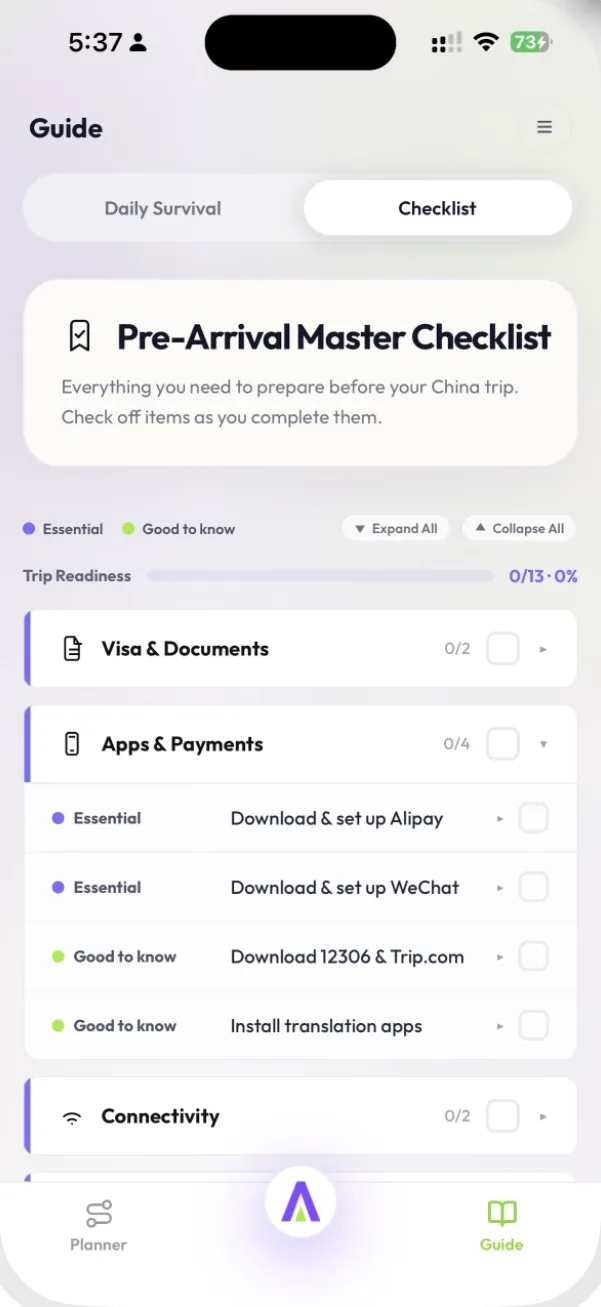
Official reference: China’s payment service guide for overseas visitors. Check current app prompts and issuer terms for your card.
03 / CONNECTIVITY
Decide how your phone will connect after landing
Choose between home-carrier roaming, a compatible travel eSIM or a local SIM based on your device and trip. Confirm mainland China coverage, allowance, validity, activation timing and whether the plan includes calls or only data.
If you choose a travel eSIM, check your exact phone model and carrier-lock status before buying. Install it on reliable Wi-Fi when the provider recommends, and follow its instructions for activation. Installation and the start of a plan’s validity period may happen at different times.
Think about your regular number too. A data-only plan may not receive ordinary SMS messages. Ask your home carrier how to keep essential verification messages available and what charges might apply.
Device reference: Apple’s guide to using eSIM while traveling internationally. Confirm the specific plan’s coverage and setup with its provider.
Install the tools you expect to use
Set up a map app suited to your destination, a translation tool and any transport or booking apps your route requires. Sign in and learn the basic screens before departure. Where supported, download the language packs or map areas you need; also save your hotel address separately.
04 / ACCOMMODATION & BOOKINGS
Confirm the reservations that shape your route
Start with your first accommodation, major city-to-city journeys and any attraction you would be disappointed to miss. Check dates, cancellation terms, passenger details and the booking channel’s confirmation status. For attractions, verify reservation requirements directly with the venue.
For accommodation, confirm the exact property, arrival time, check-in instructions and Chinese address. Ask how passport registration will be handled. Hotels register foreign guests; if you are staying in a private home or another non-hotel residence, arrange the required registration with your host within 24 hours of arrival at that accommodation.
Official reference: NIA accommodation registration notice (Chinese). Online registration for non-hotel stays was expanded nationwide from 21 September 2026; follow the official process for your stay.
If your trip includes trains
Check the passenger information against the passport you will carry, and read the full station name. “Beijing” and “Beijing South” are different stations. China Railway’s English 12306 platform accepts eligible valid foreign passports; carry the identity document used for the ticket when traveling.
Official reference: China Railway 12306 ticketing FAQ.
If the route is still taking shape, use trisAino Planner to build a day-by-day framework. Then confirm transport and reservations separately: a proposed itinerary is a planning aid, and each booking needs its own confirmation.
05 / YOUR FIRST HOURS
Make a simple airport-to-hotel plan
Give your arrival day a little breathing room. Allow for immigration, baggage, getting connected and reaching the city. Pick one practical transfer and a fallback, especially if you land late or travel with children or several bags.
| Detail | What to keep handy |
|---|---|
| Arrival point | Airport name, terminal and local arrival time. |
| Accommodation | Chinese name and address, phone number and booking reference. |
| Main transfer | Pickup instructions or the route and relevant operating hours. |
| Fallback | An alternative transfer and a contact for delays. |
Save this note locally as a screenshot, document or note that opens without data. Keep a second copy of essential arrival details outside your main phone, such as a printed page or a travel companion’s device.
06 / PACKING & CONTACTS
Pack for your route and save the people you may need
Check the forecast for each destination, your baggage allowance and the walking involved. Put travel documents, essential medication, charging cables and arrival information somewhere easy to reach. Check plug compatibility and the voltage range printed on your electronics.
If you are taking domestic flights in China, check power-bank rules before packing. CAAC prohibits power banks without clear CCC markings and recalled models or batches on domestic flights. Your airline’s current capacity, quantity and carriage rules also apply.
Official reference: CAAC notice on power banks on domestic flights.
Save your accommodation contact, travel insurer’s assistance line, an emergency contact and your embassy or consulate’s details. If you want help with reservations or travel communication, review trisAino’s optional human Concierge service before departure so you understand its scope and service hours.
The day before departure
Run one final check on the phone you will carry
- Open your flight and accommodation confirmations.
- Recheck the entry guidance that applies to your journey.
- Confirm your data plan’s installation and activation instructions.
- Open your payment apps and check access to verification messages.
- Switch briefly to airplane mode and open your saved arrival note.
- Check your transfer, weather and first-day schedule.
- Charge your devices and put your passport in your hand luggage.
For a day-by-day sequence, see our guide to the final week before departure.
First China trip: common questions
When should I start preparing?
Start entry arrangements and important bookings as soon as your dates become likely, allowing for any application or reservation lead times. Use the final week to finish phone setup, verify confirmations and save the information you will need on arrival.
Should I set up Alipay and WeChat before departure?
Yes. Allow time to register, link an eligible card and complete any requested checks. Confirm your first merchant payment after arrival, and carry a physical card and some RMB cash as backup.
Do I need an eSIM for China?
An eSIM is one option. Home-carrier roaming or a suitable physical SIM may also fit your trip. Compare coverage, compatibility, activation instructions, calls and data before choosing.
What should I save offline?
Prioritize your accommodation’s Chinese name and address, transfer instructions, booking references and useful contacts. Store document copies securely, and carry the original identity documents required for travel.