Your First 24 Hours in China Start Before You Fly

The first day is won before landing
China is not unusually hard to travel in, but several systems that matter immediately after arrival—identity checks, mobile data, QR payments, maps, transport, and hotel registration—may work differently from what a first-time visitor expects. The stressful version of day one is trying to solve all of them while tired, offline, and carrying luggage.
The practical goal is not to install every China-related app. It is to make the first journey—from aircraft door to hotel room—work even if one tool fails. The 14 items below follow the trisAino Pre-Arrival Master Checklist and add the safeguards that recur across official guidance and independent travel checklists.
The 14-item checklist at a glance
1. Confirm your visa, visa-free entry, or transit eligibility—and use the correct route.
2. Check passport validity and save secure offline copies of essential documents.
3. Install and complete the basic setup for Alipay.
4. Install and complete the basic setup for WeChat and Weixin Pay, if available.
5. Test payment readiness and prepare at least two backups.
6. Set up China Railway 12306 and/or an English-language booking platform.
7. Install a translation tool and download an offline Chinese language pack.
8. Choose and activate a primary mobile-data option before departure.
9. Install a China-ready map and save offline arrival information.
10. Check whether your dates overlap a major public holiday or peak travel period.
11. Confirm the hotel can process your passport and note the accommodation-registration rules.
12. Reserve capacity-limited attractions through official channels.
13. Pack the few items that are difficult to replace on arrival, including compliant power equipment and medication.
14. Carry or withdraw a modest RMB cash buffer rather than relying on one payment app.
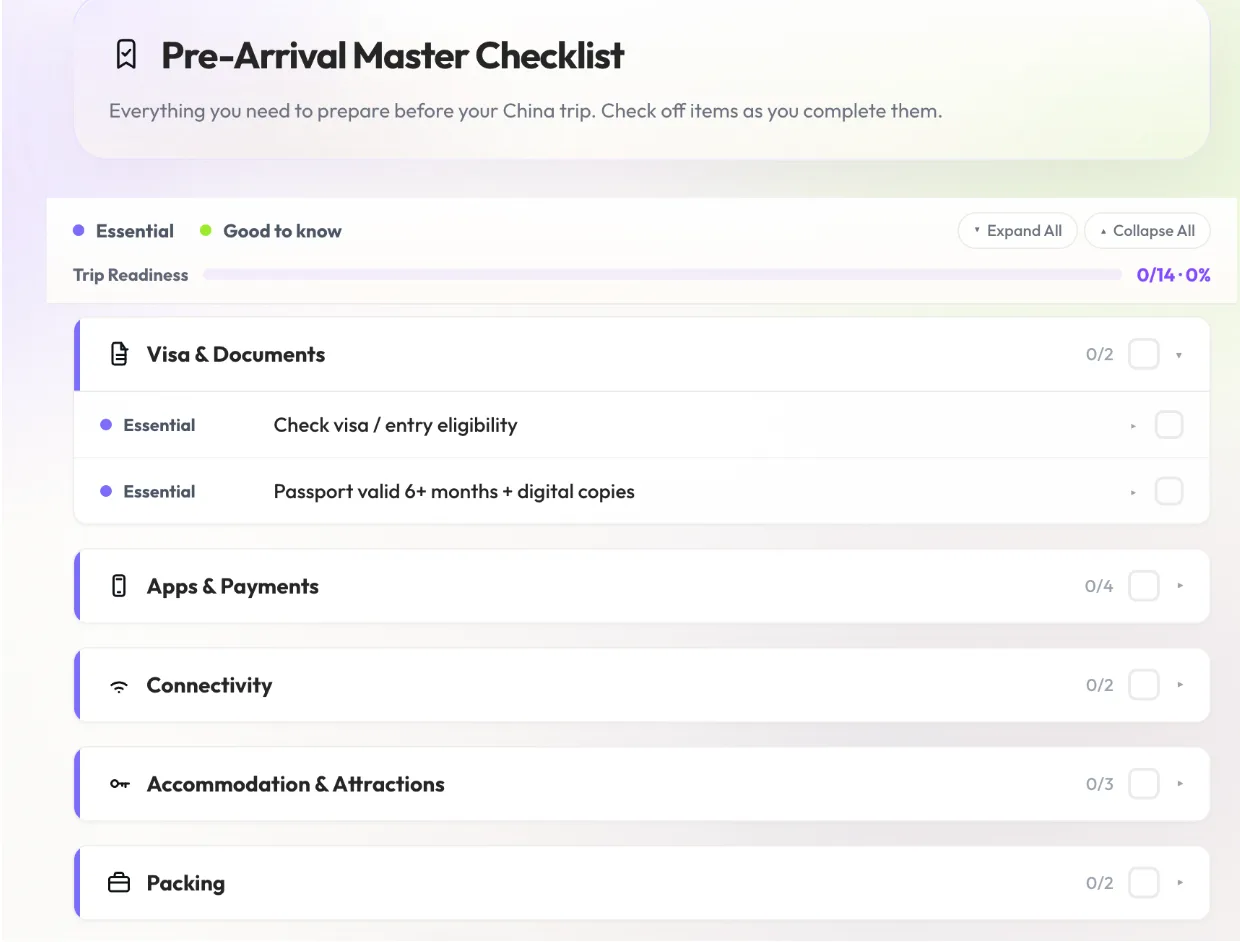
CHECK YOUR PROGRESS IN THE GUIDE
Prefer a live checklist? Open the trisAino Guide to mark each of the 14 items as complete. Every checklist item also opens into a detailed, step-by-step tutorial with screenshots, so you can follow the setup instead of piecing it together from separate searches.
A. Entry and identity: remove uncertainty first
1. Confirm visa or visa-free entry eligibility
Match the rule to your nationality, passport type, trip purpose, length of stay, arrival port, and complete route. A regular visa exemption and the 240-hour transit visa-free policy are not interchangeable. Transit users need a confirmed onward journey to a third country or region, must enter through an eligible port, and must remain within the permitted area.
Also check the arrival-card process. Since 20 November 2025, most foreign travelers can submit the China Arrival Card online before travel through official National Immigration Administration channels. The service is free; paper and port-based options remain available. Avoid look-alike websites that charge a fee.
Ready when: you can explain your entry basis in one sentence and have the visa, exemption evidence, onward ticket, and official policy page saved offline.
2. Check the passport and build one secure arrival folder
Passport-validity requirements depend on your visa, visa-free entry, or transit basis. Check the applicable Chinese authority and your airline before departure. Names and passport numbers must match every booking exactly.
For example, the 240-hour visa-free transit policy currently requires a valid international travel document with at least three months’ remaining validity. See the official National Immigration Administration (NIA) policy.
Create a secure offline folder—not a public shared link—with the passport photo page, visa or visa-free basis, flight and onward itinerary, hotel confirmation, hotel name and address in Chinese, insurance details, emergency contacts, and any essential prescriptions. Keep one paper copy of the hotel address separate from your phone. Carry the physical passport: it is commonly required for hotel check-in, rail travel, and some attractions.
B. Payments and booking accounts: complete setup while support is reachable
3. Set up Alipay
Register with the same name and passport details used for travel, complete any identity checks, and link an eligible international card. Your issuing bank may need to approve the link or a later transaction, so make sure you can still receive its SMS, email, or app-based verification while abroad.
Do not treat a successfully linked card as a guarantee that every merchant or mini-program will accept it. Save the provider's support route and keep a second card from a different issuer if practical.
4. Set up WeChat and Weixin Pay as a second route
WeChat is useful for messages, official accounts, and mini-programs; Weixin Pay can provide a second mobile-payment route. Register before departure and complete any identity or security prompts that appear. Some accounts may need additional verification, so leave time to resolve it rather than beginning at the airport.
5. Test payment readiness—and plan for failure
Where the provider allows it, complete a small legitimate test or at least verify that the wallet opens, the card remains linked, and bank authentication works. Then prepare three fallbacks: another wallet or card, the physical bank card itself, and RMB cash. Chinese official guidance explicitly presents mobile payment, bank cards, and cash as complementary options.
PAYMENT BACKUP RULE
One phone + one wallet + one card is still one point of failure. Separate the backups: keep a second card away from the first, preserve access to bank verification, and carry enough cash for the airport transfer, a simple meal, and unexpected deposits.
6. Prepare 12306 and an English-language booking option
China Railway's 12306 website and app are the official rail channels. Register with the passport you will carry, enter the name exactly as instructed, and complete any identity steps early. A valid passport is used for real-name ticketing and boarding; a screenshot or itinerary sheet is not a substitute for the travel document.
Trip.com or another reputable English-language platform can be a useful secondary interface for hotels, flights, and trains. Compare fees and support terms, and keep the operator's confirmation as well as the booking platform's reference.
C. Phone readiness: data, language, maps, and the first ride
7. Install translation tools and offline Chinese
Install at least one translation tool that supports offline Chinese text and camera translation. Download the language pack before departure and test it in airplane mode. Save a short note with your hotel name, address, dietary restrictions, allergies, and a request to call the hotel.
8. Choose and activate a primary data option
Choose international roaming, a travel eSIM, or another confirmed service before flying. Check that the phone is unlocked, the eSIM profile is installed, data roaming settings are understood, China is covered, hotspot use is allowed if needed, and the plan starts on the intended date.
Access to international apps varies by provider and routing; do not assume that every eSIM behaves the same way. Keep the activation QR code and instructions offline. Your fallback can be airport Wi-Fi plus saved hotel details, not necessarily a second paid plan.
9. Download a China-ready map and save the route offline
Amap (Gaode Maps) is a strong local option, and Apple Maps can be practical on iPhone in mainland China. Google services may be inaccessible or unreliable, and map data can be less useful for local navigation. Save the Chinese name of the airport, terminal, hotel, nearest metro station, and the first transfer route.
Write down the first three moves after arrivals: where to go, which transport to take, and how to recognize the stop or destination. If taking a taxi or ride-hailing car, keep the address in Chinese and verify the official pickup area. Do not schedule a timed attraction immediately after landing.
D. Timing, accommodation, and reservations
10. Check public holidays and peak travel dates
Spring Festival, the National Day holiday period, and other public holidays can change transport availability, hotel prices, and attraction capacity. Check the current year's official holiday calendar rather than relying on last year's dates. If travel overlaps a peak, reserve intercity transport and key attractions earlier and add queue time to the arrival plan.
11. Confirm hotel check-in and accommodation registration
Chinese authorities have stated that hotels should not reject foreign guests by claiming they lack 'foreign-related qualifications.' In practice, a small property may still have staff or passport-registration difficulties. Message the property before travel, confirm late-arrival arrangements, deposits, and international-card acceptance, and keep the reply.
Hotels normally register foreign guests. If staying in a private home or other non-hotel accommodation, registration is generally required within 24 hours; procedures vary by location, and a 2026 online pilot applies only in specified regions. Confirm the current local method with the host or the NIA 12367 service.
12. Book capacity-limited attractions through official channels
Major museums and attractions may use real-name, timed-entry reservations and can sell out. Check the venue's official website, official account, or verified mini-program; confirm the booking window, closure days, accepted passport format, cancellation rules, and whether every traveler needs an individual reservation.
Use the same passport details as the booking and carry that passport on the day. Save the reservation confirmation offline, but treat it as proof of booking—not a replacement for the ID used to reserve.
E. Packing and money: protect the parts your phone cannot solve
13. Pack essential documents, health items, and compliant power equipment
Bring prescription medication in original labeled packaging, enough for the trip plus a delay buffer, and supporting documentation where appropriate. Check legality with the relevant Chinese embassy or consulate, especially for controlled medication. Review routine vaccines and destination-specific health advice, and consider travel medical and evacuation insurance that fits the itinerary.
China uses 220V/50Hz electricity and commonly encountered socket types include A, C, and I, so confirm that chargers accept 220V and carry a suitable adapter. If taking domestic flights in China, power banks without a clear CCC/3C mark, with an unclear mark, or from recalled models are prohibited under CAAC rules effective since June 2025. Keep battery ratings visible and follow the airline's lithium-battery rules.
14. Carry a realistic RMB cash buffer
The trisAino checklist suggests RMB 1,000–2,000 as a backup; treat that as a planning range, not an entry requirement. Adjust it to trip length, group size, deposits, and comfort level. Cash is useful when a wallet, card network, or phone fails, and official guidance confirms that RMB cash remains a supported payment method.
If withdrawing from an ATM, use one displaying your card network's logo, review fees, and choose to be charged in CNY when offered a conversion choice; your home bank's rate is often more transparent than dynamic currency conversion. Carry smaller notes where possible because a small merchant may not have change for a large bill.
Your first-24-hours arrival sequence
1. Before landing: keep your passport, arrival-card confirmation or plan, hotel address in Chinese, and onward itinerary within reach.
2. At the airport: complete immigration and baggage steps before changing settings or reorganizing documents.
3. Connect: activate the planned data service, but keep moving with offline instructions if setup takes longer than expected.
4. Confirm money: open the primary wallet, verify the linked card, and keep cash or a physical card available for the first transfer.
5. Transfer: follow the saved route or official taxi/ride-hailing pickup process; check the vehicle and destination before departure.
6. Check in and reset: present the physical passport, confirm registration, connect to hotel Wi-Fi, eat an easy nearby meal, and review the next day's bookings.
If one essential system fails
· No data: show the printed Chinese hotel address, use airport Wi-Fi, or ask an official information desk to contact the hotel.
· Wallet rejected: try the second wallet or card, then use RMB cash; contact the issuing bank only through saved official channels.
· Map unavailable: use the saved station name and route screenshots; ask hotel or airport staff to write the destination in Chinese.
· Hotel cannot process check-in: show the written confirmation, contact the booking platform, and use the saved backup property rather than searching from scratch late at night.
· Flight or baggage delay: notify the hotel, preserve receipts, and check the insurer's reporting requirements before incurring major costs.
Frequently asked questions
Do I need all 14 items for every trip?
No. The list is a control panel, not a shopping list. Visa rules, rail accounts, attraction bookings, and medication paperwork depend on the route and traveler. Every visitor should still resolve identity, connectivity, payment, transport, accommodation, and offline backups.
Do I need both Alipay and WeChat Pay?
Not always, but two payment routes reduce risk. If only one wallet can be set up successfully, pair it with a physical bank card and RMB cash instead of spending hours forcing a second account.
Should I buy an eSIM or a local SIM?
Choose based on device compatibility, trip length, the need for a Chinese phone number, and which apps must work. A travel eSIM is often faster on arrival; a local SIM may suit longer stays or services that need a mainland number. Confirm the exact plan rather than relying on category-level claims.
Is the trisAino Guide an official source?
No. It is a practical planning resource that organizes common travel tasks. Use official immigration, transport, payment, aviation, health, and venue sources for rules that affect entry, safety, money, or reservations.
CONTINUE IN THE GUIDE
When you are ready to prepare, use the trisAino Guide to check your completion status and open the detailed screenshot tutorials for payments, apps, connectivity, bookings, accommodation, and the rest of the pre-arrival checklist.
Sources and update notes
Policy-sensitive facts were checked against the sources below on 28 July 2026. Independent checklists were used to identify repeated practical failure points; official sources control where the two conflict.
Official and primary references
National Immigration Administration. Online Arrival Card and expanded entry measures — official online arrival-card channels and exemptions; effective 20 November 2025.
National Immigration Administration. Beware of fraudulent Arrival Card websites — the official filing service is free.
National Immigration Administration. Visa-Free Transit Policies — 240-hour transit conditions, eligible nationalities, ports, and permitted areas.
The State Council of the People's Republic of China. Payment service guide for overseas visitors to China — mobile payment, bank-card, and RMB cash options.
China Railway 12306. Ticketing FAQs — real-name tickets, passport use, e-tickets, and official purchase channels.
National Immigration Administration. Regulations on Filing Accommodation Registration for Foreigners — hotel and non-hotel accommodation registration.
Civil Aviation Administration of China. CAAC bans power banks without CCC markings on domestic flights — domestic-flight rule effective 28 June 2025.
U.S. Centers for Disease Control and Prevention. China — Traveler View — vaccination, health packing, and travel medical insurance guidance.
Supplementary checklist and practical sources
Trip.com. How to Pay in China for Foreigners — traveler-facing payment setup and connectivity dependencies.
China for Travelers. China Pre-Trip Checklist 2026 — time-ordered setup, app, hotel, booking, and offline-backup prompts.
CHOICE. Travel Checklist: China — insurance, medication, emergency contacts, bookings, and document copies.
trisAino Guide. Pre-Arrival Master Checklist — the 14-item structure used for this rewrite.